

Moses basket or cradle: how long can your baby sleep in one?
A baby can sleep in a Moses basket from birth and during the first few months, while a crib remains suitable for a little longer. After that, a cot, often convertible, takes over. These age guidelines are no substitute for watching your baby, however: their mobility and your attentiveness are the most reliable signs that it is time to change their sleeping space.

A baby can sleep in a Moses basket from birth to around 4–6 months (or up to 9 kg, depending on the manufacturer), while a cradle remains suitable a little longer, generally until 6 months. After that, a cot takes over, often from 6 months until the age of 2 or 3. These age guidelines can never replace watching your child, however: their mobility is the most reliable sign that it is time to change their sleeping space.
Moses basket and cradle: two different sleeping spaces with different age limits
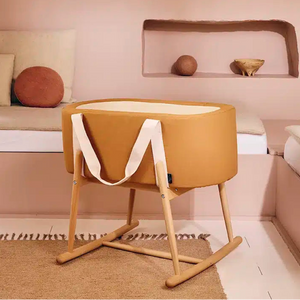
The Moses basket is a lightweight basket with two handles that you can move from room to room: ideal for keeping your baby close during naps or when they're awake.
The cradle, by contrast, is more like a small cot: sturdier and sometimes fitted with wheels, it is more often kept in the bedroom.
This difference in design explains why the age limits are not the same. A Moses basket, with its more compact shape, is suitable only for the first few months. A cradle, being wider and deeper, can accommodate your baby a little longer before the move to a cot. Comparing the age limit for a Moses basket with that for a cradle without distinguishing between the two therefore makes little sense: each serves a different purpose in your baby’s room.

Up to what age and weight can a baby sleep in a Moses basket?
A baby can sleep in a Moses basket from birth until around 4 to 6 months, or until they reach the maximum weight, generally around 9 kg depending on the manufacturer. A baby who grows quickly may reach this limit well before 6 months, while a smaller baby may use their Moses basket a little longer.
Beyond age and weight, it is above all your baby’s mobility that determines when it is time to make the move:
- Rolling over: as soon as your baby can roll over unaided, the sides of the Moses basket, often 15 to 25 cm high, are no longer enough to keep them safely inside.
- Not enough space: if your baby’s head and feet already touch opposite ends of their sleeping space, they no longer have enough room to move freely while asleep.
- Reaching the weight limit: the frame and handles may start to weaken as your baby approaches the maximum weight.
At Charlie Crane, the KUKO carrycot can be used from birth to around 6 months and becomes a cradle with the addition of a wooden stand. This gentle transition supports each stage of your baby's growth without rushing them. To compare the available models, explore this selection of baby cradles and carrycots.

How long is a cradle suitable for your baby?
While a Moses basket may become too small at just 4 months, a cradle can generally be used until your baby is around 6 months old. The difference comes down to size: wider and deeper than a Moses basket, it gives your baby more room to move without becoming unsafe as soon as they first try to roll over.
As with a Moses basket, the real guide is not just the age stated in the instructions but your baby’s mobility. Once they push themselves up on their arms, or their head and feet touch the ends of the cradle, the space is too small for safe sleep: it is time to prepare for the move to a cot.
Some cradles, particularly bedside sleeper models attached to the parents’ bed, can extend this period by making night-time breastfeeding or bottle-feeding easier during the first few months. Whichever model you choose, it is best to opt for a healthy, durable solid wood cradle and check that the mattress provides firm support, an essential condition for peaceful sleep until your child moves to a bed.
Signs that your baby has outgrown their sleeping space
Whatever sleeping space you use, three physical signs deserve more attention than a fixed age limit:
- Rolling over: as soon as your baby can roll over unaided, from back to front or the other way round, the low sides of the Moses basket or cradle are no longer enough to keep them safely inside. There is a real risk of it tipping over, especially if the sleeping space is on a raised stand.
- Pushing up: when your baby pushes up on their hands or feet to lift themselves or try to sit up, the confined space no longer meets their need to move.
- Baby’s body touching the sides: when your baby’s head and feet touch opposite ends of the sleeping area, they have no room left to move freely, which can also disrupt their sleep – and yours!
Every child grows at their own pace. Watching for these signs helps you calmly prepare for the move to a cot, which is better suited to a more mobile baby.
Moses basket, cradle or cot: comparing ages and safety criteria
| Sleeping space | Age range |
|---|---|
| Moses basket | from birth to around 4–6 months |
| Crib | from birth to around 6 months |
| Cot | from 6 months to 2 or 3 years |
| Adjustable bed | up to 6 or 8 years |
This comparison highlights a simple principle: each sleeping option has its own place at a particular stage in your baby's room, rather than replacing the others. The carrycot is light and portable for the earliest months, the cradle extends that cosy feeling with greater stability, and the cot takes over when your child needs more room to move. The convertible bed, meanwhile, is designed to last, accompanying your child for several years. To choose with confidence, always weigh these age guidelines against what you observe in your child day to day: this table is a guide, not a hard-and-fast rule — you know your baby best!
Why shouldn’t you use a Moses basket beyond the recommended age?
Using a Moses basket for too long is not just about exceeding an age guideline: above all, its stability and space may no longer keep pace with your baby's mobility. A Moses basket has low sides by design, intended for a newborn who is not yet moving around. Once your baby starts rolling over independently, pushing up on their arms or pushing with their legs, those same sides become a weakness, with a real risk of tipping if the Moses basket is placed off the floor, even on its stand.
The inside length presents the same problem: a baby who already touches both ends of their sleeping space no longer has room to stretch out or move freely while asleep. A Moses basket is designed as a cosy space for a short period, not a long-term bed. Its lightweight frame, handles and compact size make it easy to move around the home in the first few months, but it is not intended for a growing child to sleep in for an extended period.
After this stage, it is better to move to a cradle and then a cot. Both are designed for a bigger, more mobile baby, offering more room and greater stability. Watching your baby remains the best guide: their mobility, rather than their exact age, tells you when it is time to change their sleeping space.

How can you help your baby move from a Moses basket or cradle to a cot?
It is better to prepare for the transition than to make it at the last minute. As soon as your baby can roll over unaided, touches both ends of their sleeping space or approaches the manufacturer’s stated maximum weight, it is time to plan a gentle move:
- Plan ahead without rushing: set up the cot in the bedroom a few days before the move so your baby can get used to seeing this new space, which is bigger than their Moses basket or cradle.
- Keep familiar comforts: the same sleeping bag, the same cuddly toy and, if possible, a sheet that already smells like your baby can help connect the old, cosy space with the new cot.
- Check the safety of the cot, whether it has bars or not: bar spacing that complies with NF EN 716 (see securidou.fr), a firm mattress that fits the sleeping space exactly, and a mattress base set to its highest position for the first few weeks to make everyday care easier.
- Take it step by step: a few naps in the cot before your baby sleeps there all night can reassure both your baby and you.
- Pay attention to your baby’s needs: age is only a guide; what matters most is their comfort and safety in their new sleeping space.
A cot with or without bars, made from healthy, durable solid wood, can then serve your baby for several years in a room designed to grow with them.

Frequently asked questions
Up to what age can a baby sleep in a Moses basket? Generally up to 4–6 months, or up to 9 kg, depending on the manufacturer. The most reliable sign, however, is when your baby first rolls over.
How long can you use a cradle? A cradle remains suitable until around 6 months, sometimes a little longer for certain bedside models, thanks to its larger sleeping space compared with a Moses basket.
When should your baby move from a Moses basket or cradle to a cot? At around 6 months, or sooner if your baby can roll over unaided, push up on their arms or already touches the sides of their sleeping space.
Are Moses baskets and cradles suitable for overnight sleep? Yes, provided they are placed on a flat, stable surface, with a firm, correctly sized mattress and nothing else in the sleeping space.
Should you replace the mattress in a second-hand Moses basket or cradle? It is recommended that you always replace the mattress, even if it appears to be in good condition, as hidden moisture can encourage mould growth.


