

Bouncer, swing, or rocker: what are the differences?

Between the bouncer that moves with baby's kicks, the swing that rocks mechanically, and the rocker that oscillates with gentle fluidity, it is easy to get confused. The difference essentially comes down to the type of movement: natural and manual for the bouncer, motorised for the swing, oscillating and enveloping for the rocker — three ways of offering baby a reassuring cocoon while parents catch their breath.
Baby bouncer or swing: what’s the real difference?
The bouncer is a fixed or gently rocking seat placed on the floor, in which baby rests or observes the world without any motorised assistance: it is the movement of baby's own legs, or a gentle nudge from a parent, that sets it in motion. The swing adds an automated rocking mechanism, often electric, which reproduces the reassuring back-and-forth of a parent's arms, with adjustable speeds and sometimes a built-in play arch or lullabies. The rocker, a term less common in France, refers to a rocking chair with a fluid, enveloping motion, designed for soothing rather than active stimulation. A vocabulary distinction worth knowing, even if in everyday use among French families, this difference is often absorbed into the two main categories of bouncer and swing.
Three different ways, then, to give baby a comfortable space while parents have their hands free:
- the baby bouncer appeals with its lightness and unobtrusiveness: quiet and portable, it moves effortlessly from room to room;
- the swing focuses on extended comfort and sensory stimulation, sometimes offering several recline positions;
- the rocker remains above all a space for passive rest, designed for the very young baby who simply needs gentleness.
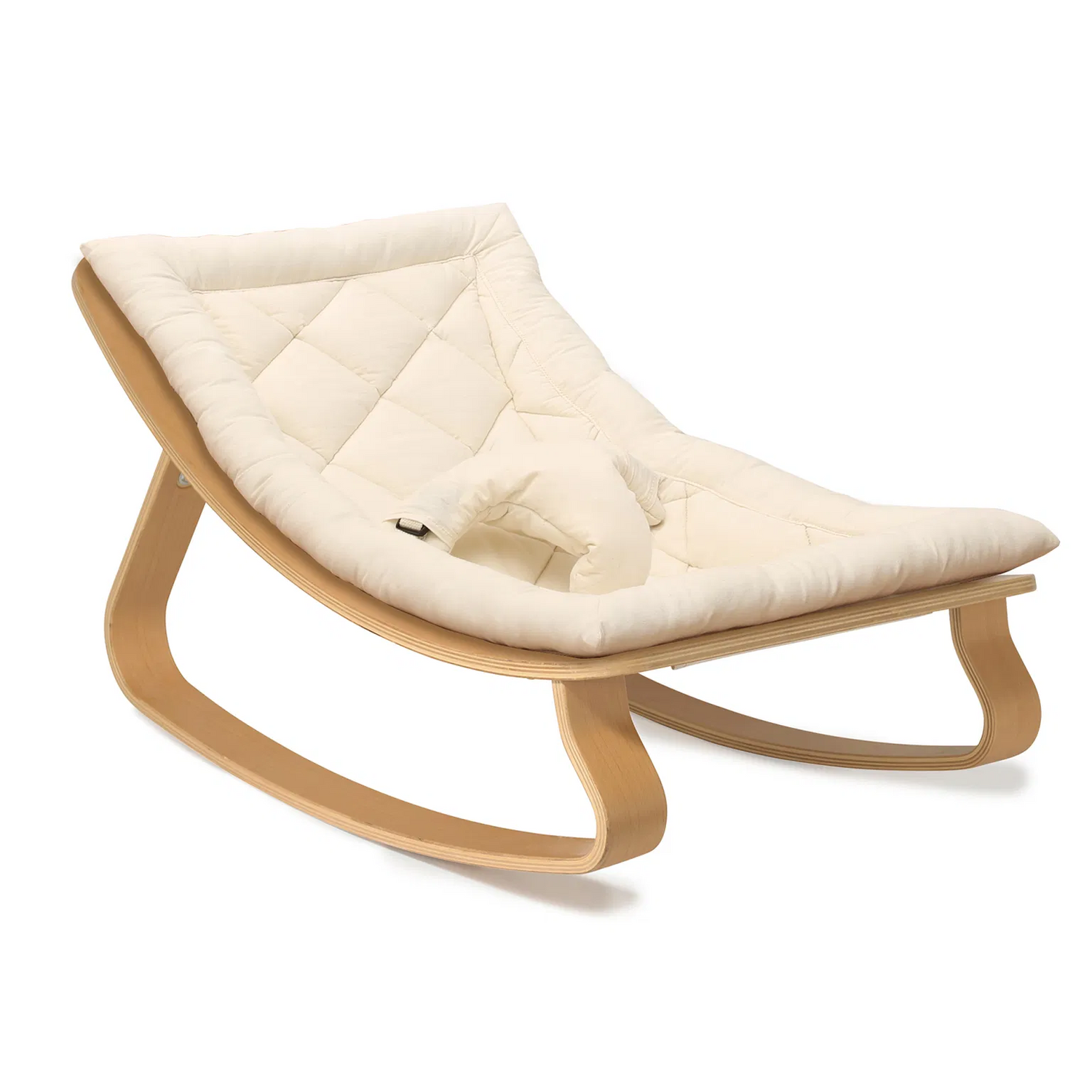
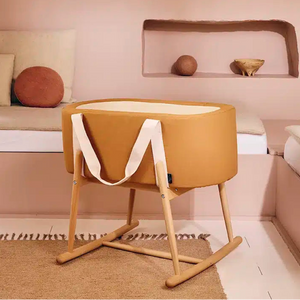
At Charlie Crane, this philosophy of creating a familiar landmark is reflected in a particular approach: conceiving the bouncer as a piece of furniture in its own right — aesthetic and lasting — rather than a simple functional item. It is the subtlety of French design that resonates internationally; when aesthetics meet functionality, the bouncer becomes an object that belongs in the living room, not just in the nursery.
The baby bouncer: what is it actually for?
A baby bouncer is a small reclining seat placed on the floor, designed to hold baby in a semi-reclined position from the very first weeks of life. Unlike a swing, it stays still or moves slightly in response to the child's movements: no motor, no programming, just a natural, gentle rocking motion. It is this simplicity that makes it an everyday object — light, easy to move from room to room, so baby can stay close while you cook, work, or take a call.
At Charlie Crane, the baby bouncer range perfectly embodies this philosophy: where aesthetics meet functionality. The designs are conceived with use in mind as much as appearance, with a seat shaped like a snug cocoon where baby can rest, observe their surroundings, or wait calmly before a feed. The subtlety of French design is reflected in the choice of materials: soft, breathable, easy-to-care-for fabrics — true comfort for a newborn's delicate skin, thanks in particular to removable, machine-washable covers.
The baby bouncer fits naturally into a small urban flat: compact, it can be stored away effortlessly. It supports baby through the first few months, until they learn to sit up on their own, before making way for other equipment. It’s amazing how such a simple piece of furniture becomes a discreet companion during the first weeks of life, without ever replacing the attentive presence of an adult.

The baby swing: how it works and everyday use
The principle is based on a back-and-forth rocking motion that reproduces the rhythm of a parent's arms: this is what fundamentally distinguishes the swing from the bouncer, whose rocking remains natural and triggered by baby's own movements. Two approaches coexist depending on the model:
- the manual mechanism requires a gentle nudge from the parent — a hand placed on the seat, a foot softly pushing the base — to set off a smooth, silent rocking motion, with no electronics involved;
- the motorised mechanism takes over autonomously: an electric system maintains the oscillation at an adjustable speed, freeing the parent's arms and attention for a few precious minutes.
In practice, this makes a significant difference to daily life. An electric swing allows you to rock baby while preparing a meal or having a shower, with several rocking speeds to suit baby's mood — faster to soothe a fussy spell, slower to ease them off to sleep. A manual swing requires a more continuous presence, but is just as soothing: the parent's repeated gesture has something reassuring about it for the child too.
At Charlie Crane, this thinking about movement informs the design of their baby bouncers, conceived to gently accompany baby's waking and resting moments, in an approach where comfort and simplicity of motion take precedence over a proliferation of automated features.
At what age and up to what weight can each of these products be used?
Bouncers, swings, and rockers all cater to the same age range: the very first months of life. These products are designed to welcome baby from birth until they can sit up unaided — a pivotal milestone that varies from child to child and marks the point at which a reclined seat is no longer suited to their emerging mobility.
A few simple principles apply, whatever equipment you choose:
- place the seat on the floor, never on a table or raised surface;
- always fasten the harness as soon as the child is seated;
- limit continuous periods of use to protect the comfort of baby's back and neck;
- avoid leaving baby to sleep in it for extended periods, favouring the most reclined position possible for short naps.
As every product has its own safety thresholds, it is always essential to check the manufacturer's precise guidelines rather than relying on a general average.

The Charlie Crane adaptive bouncer: a lasting answer to the choice between bouncer, swing, and rocker
Rather than accumulating equipment over the months, Charlie Crane designs seats intended to support baby over time, without compromising on design. The collection of baby bouncers available on charliecraneparis.com meets the need for an object that is both aesthetically pleasing and functional, fitting naturally into a living room or bedroom in a flat, without the bulk sometimes associated with larger electric swings.
This approach speaks to the concerns of young parents who care about ecology and their child's wellbeing:
- a comfortable cocoon, designed to reassure without overstimulating;
- carefully chosen materials, soft and breathable;
- a clean, pared-back silhouette that sits harmoniously in a considered interior;
- a seat designed for back and neck comfort rather than for multiplying electronic automated features.
It is also this subtlety of French design that appeals beyond borders: a careful balance between reassuring function — soothing baby, offering a safe space for discovery or napping — and formal refinement. For parents torn between a bouncer, a swing, or a rocker, this proposition deserves to be considered as a lasting alternative, designed to integrate seamlessly into daily life rather than serving as mere transitional equipment.
FAQ, bouncer, swing or rocker
What is the main difference between a bouncer and a swing? The bouncer stays still or moves naturally in response to baby's movements, with no motor, whereas the swing offers automated rocking, often electric, with adjustable speeds.
Is the rocker really different from the bouncer? Yes: the rocker oscillates in a back-and-forth motion, generally initiated by the parent or by gravity, whereas the bouncer responds gently to the child's own movements.
Can baby sleep in a bouncer or a swing? A short nap is possible, but it is recommended to avoid prolonged sleep in a semi-reclined position and to favour a flat sleeping surface for longer periods of rest.
Is a bouncer more practical than a swing for everyday use? A bouncer is generally lighter and more compact, making it easier to move from room to room, whereas an electric swing tends to be bulkier.
How do you choose between a bouncer, a swing, and a rocker? The choice depends above all on baby's temperament and the parents' lifestyle: an active movement for a curious child, a gentle, enveloping rock for a newborn who is more sensitive to stimulation.


