





Co-sleeping: they slept happily and had beautiful dreams together
To sleep or not to sleep with your baby — that is the question. We answer this big question by listing the benefits of co-sleeping.

To sleep or not to sleep with your baby, that is the question. We answer this great question by listing the benefits of co-sleeping. Benefits, WHO recommendations, safety rules…
You will have all the arguments at hand to decide whether this co-sleeping method is right for you!

Co-sleeping: what is it?
Co-sleeping comes from the English term co-sleeping, which means "sleeping together". Often, in contemporary European societies, babies have their own room from birth, where they are supposed to sleep alone. With co-sleeping, the infant sleeps at night in the parents' bedroom during the first weeks and even the first months of their life.
In fact, there are two practices within co-sleeping:
- Parents and baby share the same space, each in their own bed. The baby is in their cot or in a Moses basket, on their mattress, close to the parents' bed.
- Parents and baby sleep side by side, with a special co-sleeping baby bed pushed up against the parents' bed. In this case, it is advisable to follow certain rules that we will share with you below.
Co-sleeping around the world
So, is co-sleeping a common practice or, on the contrary, an unusual one? Well, it depends on the region of the world! In Asia, Africa, and Nordic countries (in Sweden and Norway, for example), co-sleeping is very widespread. Most families are accustomed to sleeping together.
In Europe, sleeping with your baby is slightly less normalised. Often, this practice suffers from stubborn stereotypes… Many people fear that this form of proximal parenting is the cause of long-term dependency in children towards their parents. So, myth or reality? In fact, studies tend to prove the opposite! By responding to the child's physiological needs, parents send a clear message: "You can count on us." This attachment bond strengthens the little one's sense of security and confidence. As a result, children develop their independence more easily. Yet, even among professionals and specialists, opinions continue to diverge. So what should we do? Let us listen to the WHO and list the benefits of co-sleeping.

WHO recommendations
What does the WHO, the World Health Organisation, say? The WHO recommends keeping your child in the parental bedroom during the first six months of their life, in order to reduce the risk of sudden infant death syndrome. Indeed, a baby nearby means more alert parents. Of course, parents who prefer to sleep without their baby should not feel guilty. It is a personal choice, just like breastfeeding. Our article is here to help you make an informed choice, according to your wishes and your needs.
The benefits of co-sleeping
In practical terms, what are the benefits of sharing the parental bedroom?
-
A peaceful sleep
Some parents feel reassured being so close to their baby. They can hear them, keep an eye on them… and are alerted at the slightest suspicious sound. This is also the main reason. -
Easier breastfeeding or bottle feeding
Having your baby within reach also means fewer back-and-forth trips to feed the baby who wakes up several times during the night. Night wakings are therefore lighter for everyone. No need to go to the other end of the house to pick up your baby, feed them, and then put them back to sleep. Breastfeeding mothers get better sleep… and better lactation. Bottle-fed babies and their parents also benefit from this closeness. -
A secure baby
Finally, with co-sleeping, the baby feels safe. Often, they synchronise their breathing with that of their parents. In short, a true cocoon for a good night's sleep. Of course, some parents see these benefits as drawbacks… Sharing a bedroom can be experienced as a sacrifice of parental intimacy. But let's be honest, between the post-partum period and the nights of a newborn, which are often synonymous with a severe lack of sleep, we vote for anything that makes life easier. Co-sleeping can be part of that!
The WHO recommends keeping your child in the parental bedroom during the first six months of their life, in order to reduce the risk of sudden infant death syndrome.
Co-sleeping safety rules
But be careful! To practise co-sleeping safely, it is nonetheless important to follow a few safety rules:
-
Baby must have their own bed
You should not sleep with your baby directly in your bed, as you risk crushing or suffocating them. That is why it is recommended to opt for a co-sleeping arrangement. -
Bye bye alcohol
Co-sleeping, alcohol and medication do not mix! If you are taking sleeping pills or have had (too much of) a good time, do not sleep with your baby. -
Bye bye cushion
Prevent the risk of suffocation and ban cushions, small blankets, soft toys and other textiles that could suffocate the baby in their cot and in yours. -
At the right temperature
Finally, dress your baby lightly and do not overheat the room. The ideal temperature is 18°C in the bedroom.


Our co-sleeping cot, the KODO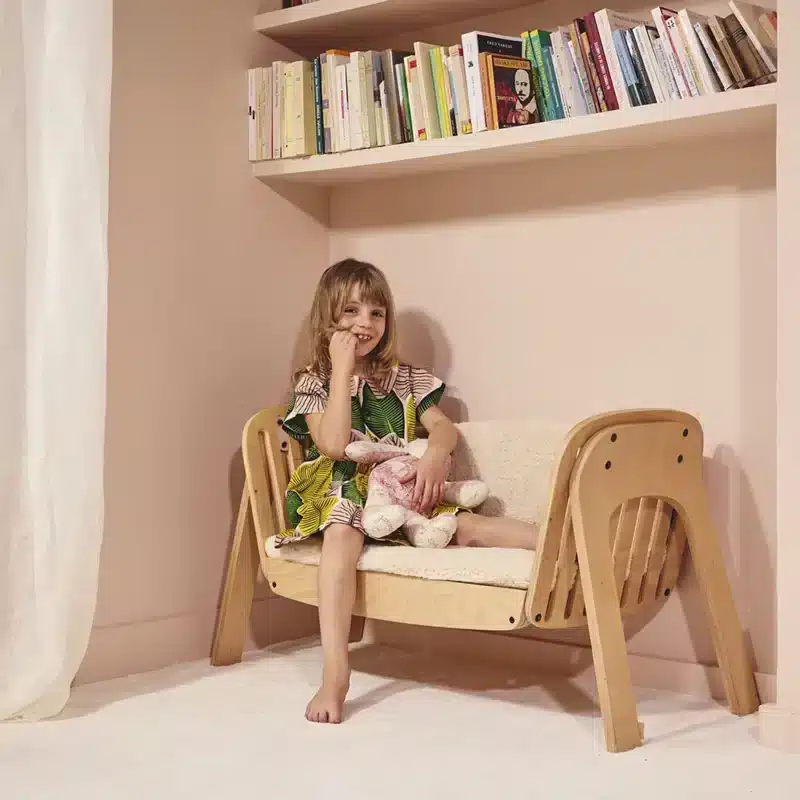

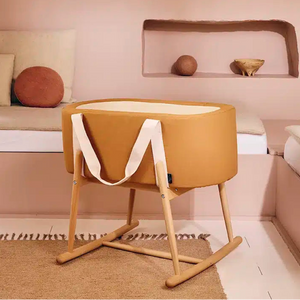
If you are tempted by this co-sleeping experience, discover our new KODO co-sleeping cot! We designed it to make your nights with a newborn easier, while preserving the aesthetics of your bedroom. Because a co-sleeping cot doesn't have to be made of plastic to be practical! And besides, a beautiful piece of furniture will also leave lovely memories in your family photos... This beech wood cot with rounded shapes fits snugly against the parents' bed. It is height-adjustable to fit perfectly with adult beds (up to 200cm). The icing on the cake: like all Charlie Crane furniture, the KODO cot has been designed to last. It is therefore adaptable and will transform into a lovely little bench seat once your baby has grown.
So don't hesitate any longer and opt for #cosleepingforall!


