

Switching to a Montessori Bed: Benefits, Age and Tips for Choosing the Right One
Discover the benefits of the Montessori bed for your child's independence. Ideal age, safety tips and a selection of adaptable beds for a free-range bedroom.

Table of contents:
Inspired by the renowned educator Maria Montessori, the floor bed transforms the sleep of little ones into a learning experience. More than just a décor trend, it is a tool in the service of awakening. Discover how to choose and set up a Montessori bed for your child.
The theory: What is a Montessori bed?
Inspired by the pioneer of education, Maria Montessori, this type of sleeping arrangement is rooted in a precise philosophy: every child learns at their own pace and develops their abilities through sensory and practical activities.
When it comes to sleep, the guiding principle is freedom. The idea is to give the child maximum freedom of movement. The Montessori bed is defined by the absence of bars or a rigid structure, allowing the child to lie down and get out of bed on their own as soon as they are physically able to do so. All of this, of course, within a 100% safe space.
From what age should you adopt a floor bed?
There is no universal age to start. While some parents wait until 2 or 3 years old, others make the transition from the first year, as soon as the child is crawling or moving around freely. Co-sleeping is often practised in the first months, but as soon as you feel ready, you can go for it! The important thing is to follow the essential safety rules for sleep without close supervision.

What are the benefits for the child (and the parents)?
- Autonomy and self-confidence: Thanks to its low position, the bed allows the child to go and rest or get up on their own to play. This freedom strengthens their sense of competence.
- Freedom of movement without risk: Without bars, your child can move freely. With a foam guard or a mattress close to the floor, the risk of a serious fall is eliminated.
- Creativity and a sustainable environment: These functional beds integrate perfectly into a bedroom designed at a child's level, with natural materials and accessible toys.
The bonus for parents: No more crying behind the bars waiting to be picked up! The child can come and find you or quietly occupy themselves in their room when they wake up.
How do you create a safe Montessori bed?
The basis is simple: a quality mattress placed on the floor (or on a very low slatted base for ventilation). Here are a few tips:
- Place the bed in a corner against the wall to create a cosy, cocoon-like feeling.
- Use a foam guard to define the space without restricting movement.
- Choose a mattress large enough to encourage freedom of movement and longevity.
- Avoid bulky pillows and soft toys for younger children to prevent any risk of suffocation.
The Charlie Crane selection: YOMI and KIMI
To combine design and pedagogy, we have created adaptable solutions that fit this philosophy:

The YOMI bed: at the right level to feel all grown up
Our YOMI bed is an excellent candidate. Crafted from natural wood in an environmentally responsible way, its design is geared towards independence.
Montessori tip: Remove the legs to place it as close to the floor as possible. Add our removable foam bed guard for a safe and welcoming space.

The KIMI bed: an unobstructed view of the world
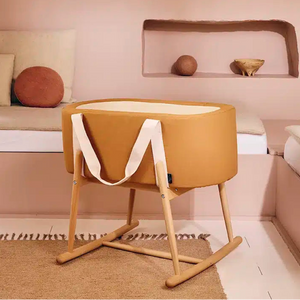
The KIMI bed can also be transformed. We designed it without bars, with a transparent fabric that allows the child to observe their surroundings without visual obstruction. Adaptable and hypoallergenic, it accompanies your child from birth through their first years of independence.
FAQ: Your questions about the transition to a Montessori bed
How do I know if my child is ready for a bed without bars?
There is no fixed age, but observe their mobility. If your child starts crawling or trying to climb over the bars of their current bed, it is an excellent sign that they are ready for the independence of a floor bed, often between 12 and 24 months.
Is the Montessori bed compatible with co-sleeping in the early months?
Absolutely. As mentioned in the article, many parents practise co-sleeping in the first months and then transition to a Montessori bed (such as the open KIMI model) as soon as they feel comfortable with their baby's mobility.
Why choose an adaptable bed such as the YOMI or the KIMI for this method?
The advantage of an adaptable bed is its longevity. By removing the legs of the YOMI bed, you create a perfect Montessori bed right at floor level. Later, you can put them back, offering furniture that grows with your child without having to buy a new bed.
Is it safe if my child gets up on their own during the night?
Safety relies on the environment: the room must be made safe ("baby-proof"). The Montessori bed eliminates the risk of a serious fall. For added comfort, the addition of a removable foam guard helps to define the space while allowing the child to get out freely if they wish.


