





Sleep: baby wakes up at night — what to do?
What counts as a full night's sleep for a baby?
Contrary to what one might think, a full night's sleep for a very young child does not correspond to 7 or 8 hours of uninterrupted sleep, as it does for an adult. For a newborn, a "full night" is defined as 5 to 6 hours of continuous sleep. This may seem short, but for a baby who, in their first months, wakes very frequently to be fed or changed, those 5 to 6 hours are already a fine achievement. A newborn's sleep patterns are indeed very different from those of adults. Cycles are shorter, around 50 minutes, with more frequent phases of light sleep. So, even if your baby starts sleeping a little longer, they may still wake up several times during the night.
When should you be concerned?
While most babies start sleeping better around 6 months, it is perfectly normal for there to be fluctuations. However, certain signs may lead parents to consult a paediatrician or a sleep specialist.
Here are a few things to look out for:
- If your baby wakes up constantly for no apparent reason (they are well fed, have no fever, no illness and their environment is soothing).
- If, despite your efforts to establish a routine or a sleep-friendly environment, your baby is still unable to sleep for longer stretches from 9 or 12 months onwards.
- If disturbed nights are accompanied by difficulty falling asleep, significant irritability, or behavioural issues during the day.
In such cases, a paediatrician can help you identify the causes of frequent night wakings and suggest appropriate solutions. However, it is essential not to feel guilty: every baby has their own rhythm, and this is not a reflection of your parenting skills. So, repeat after us: "I am a good parent".
Helping your baby sleep through the night is often a top priority for new parents. The famous expression "sleeping through the night" is synonymous with an important milestone in a baby's development, but when that long-awaited moment is slow to arrive, or is interrupted, it can become a source of worry. What should you do if baby wakes up during the night? Let us look at what "sleeping through the night" really means, at what age you can expect it, when to be concerned and, above all, how to help your child sleep better.
At what age does a baby start sleeping through the night?
Even though there is no universal rule for the age at which a baby starts sleeping through the
night, let us look at what science and research have to say.
- Between 3 and 6 months: We observe that half of babies are able to sleep at least 5 to 6 consecutive hours.
- From 6 months: a 2018 study published in Pediatrics showed that approximately 38% of babies sleep 8 hours straight through the night. This means that 57% of babies at this age still wake up at least once during the night.
-
From 12 months: it is estimated that 72% of babies sleep through the night… with some variability. Factors such as diet, the baby's temperament, or external events (teething, illness) can affect their sleep. This means that 28% of babies still have difficulty sleeping through the night.
As you will have gathered, sleeping through the night is not automatic for babies. It is important to remember that every child has their own developmental rhythm. While some sleep for several hours at a stretch from as early as 3 months, others may still wake during the night at 8 or 9 months, or even later. This does not mean there is a problem.

Practical tips to help baby fall back to sleep
If your baby is not yet sleeping through the night, a few simple adjustments can make a big difference to their sleep. Here are some practical tips to improve your child's nights and, by extension, your own:
Establishing a bedtime routine
Babies, like older children, are sensitive to rituals. Repeat the same routine every evening, preferably at the same time, with a fixed bedtime. A soothing bath, a clean nappy, a short story, gentle cuddles and a calm environment help your baby understand that bedtime is approaching. The more regular and consistent the routine, the more your child will associate it with sleep.
Creating a sleep-friendly environment
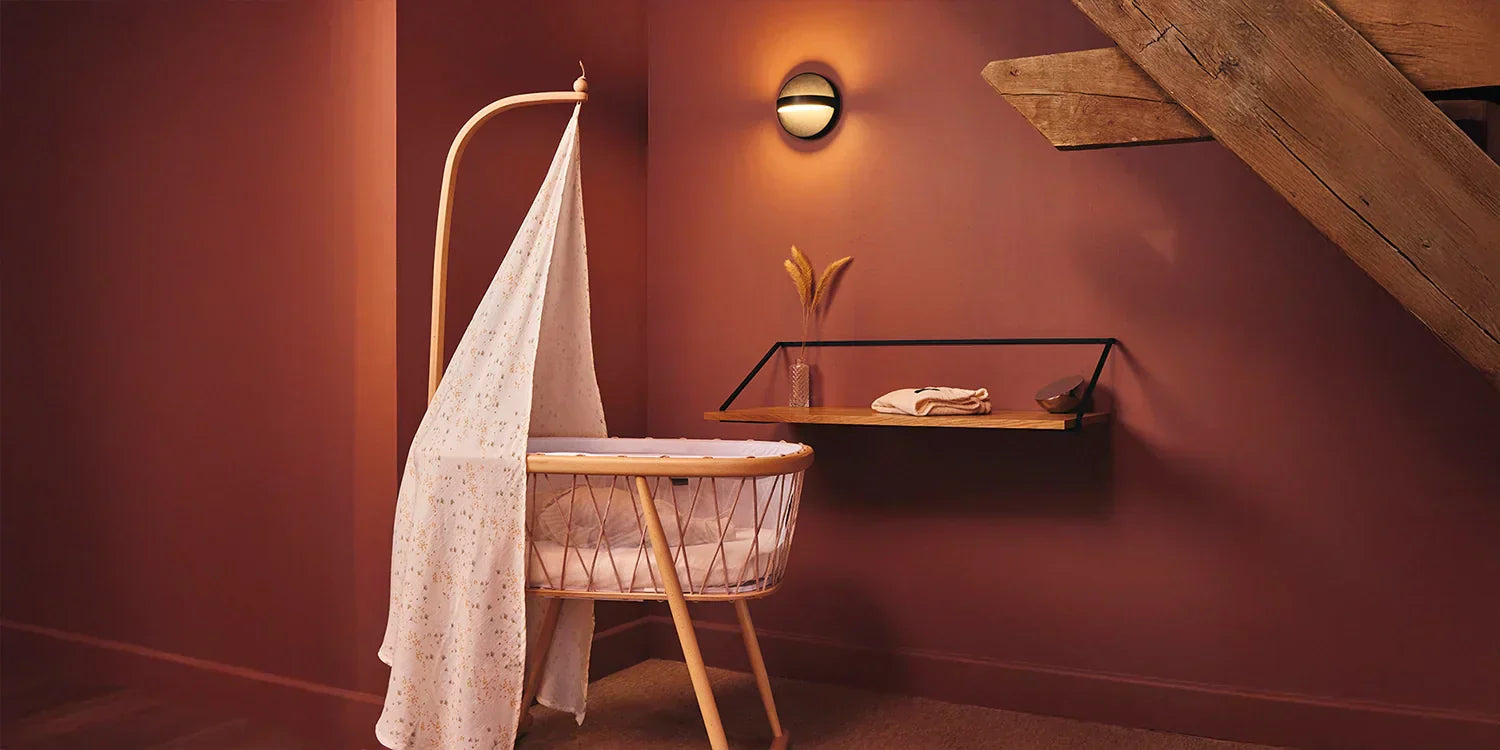
Choosing the right baby bed is essential. It should be comfortable, suited to your child's age and placed in a soothing environment. Up to 4–6 months, opt for a cradle or a Moses basket. Keep the room at a comfortable temperature (between 18 and 20°C), create darkness conducive to sleep and which will help them tell the difference between day and night. Equally, no screens before bedtime. Light disrupts the sleep cycle (in adults too, for that matter — take note…).
Identifying signs of tiredness
A point highlighted by many specialists: you need to spot the signs of sleepiness. A tired baby shows that it is time to sleep: they rub their eyes, yawn, become grumpy. If you notice these signs, put them to bed quickly before they become overtired, as this can make falling asleep more difficult.
What to do if baby wakes up during the night?
We have selected a few ideas to try at home if your baby wakes up during the night. The fear of creating bad habits. First of all, trust yourself. Many parents are afraid of creating bad habits — "Just let them cry, you'll get them used to it…" says Auntie Janine. In truth, by responding to their needs, you are strengthening their emotional security. The very security that will allow them to be more independent later on. Trust your instincts and do not feel guilty about cuddling or offering reassurance.
Identify the cause of waking
Understand why your baby has woken up. Are they hungry, too hot, in pain or in need of a nappy change? It is also worth noting that, around 4 months, babies sometimes experience a sleep regression, linked to a natural transition towards a new cycle.
Finally, from a certain age (around 18 months), babies no longer have a physiological need to feed during the night. In that case, reassure them with words. Yes, they will manage without a night-time bottle or breastfeed. Another important question: is waking up like this a habit? Observe and take note to better understand and act.
Encouraging independent sleep
If your baby wakes up in the middle of the night, try giving them a few minutes to attempt to fall back to sleep on their own before rushing in. If they cannot manage to fall asleep by themselves, go and reassure them. First without entering the room, but by speaking to them through the door, for example: "I'm here, I can hear you and everything is going to be fine".
Not working? Move on to plan B. Go into their room, bring their comfort toy
close to them, place your hand on their face, their tummy… If you feel they really need it (in the case of crying, for example), pick them up and rock them.
After soothing them, try to put baby back in their bed so they can fall back to sleep without being held in your arms. The goal: encouraging independent sleep. Even better if you have a cradle like the KUMI. You can leave your child in their bed while still rocking them.
What about a dummy to help with sleep?
Some babies feel a strong need to suck, which soothes them. In such cases, a dummy can be a real asset. Of course, be careful not to overuse it so as not to create a real dependency (in short, it is advisable to keep the dummy for certain moments only).
Other babies will take their thumb. Breastfeeding mothers are sometimes afraid of creating a "bad habit" by feeding their baby to sleep at the breast. Again, trust your instincts and talk to your paediatrician, your midwife or a sleep specialist whose approach resonates with you.
Communicate with your little one
Another piece of advice would be to reassure your baby. Do not hesitate to use your words to support them. If they are old enough, you can talk about it during the day to help them understand, guide them and make progress.
If your baby is not yet sleeping through the night, know that you are not alone. It is perfectly normal for this to take time, and every child develops at their own pace. The important thing is to remain patient, to respect your baby's specific needs, and not to hesitate to ask for help if you feel overwhelmed. With patience, a reassuring routine and a sleep-friendly environment, you will help create more peaceful nights for your child… and for yourself.


