

How to choose a mattress and bedding for a bassinet or cradle?
The number-one factor in a safe sleep space isn’t the mattress brand or material, but how precisely it fits the dimensions of the bassinet or cradle: there should be no gap between the mattress and the sides. Next come firmness, density, and thickness, followed by bedding that’s practical for everyday use and helps keep your baby as comfortable as possible. Then it’s time to plan the transition to a larger bed.

Why must the mattress fit the bassinet or cradle exactly?
A mattress that fits perfectly protects your baby better than a poorly fitting premium model: a gap between the mattress edges and the sides creates a risk of entrapment or even suffocation if your baby turns into it while sleeping.
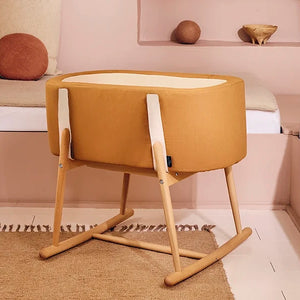
Dimensions vary by model: a bassinet most often takes an oval mattress, while a cradle may take a rectangular or oval one. Always check the measurements in the sleep space’s instructions rather than assuming there is a universal size. This precision matters more than any other factor: density or thickness can never make up for a poor fit.
Thickness, density and firmness: guidelines for a safe infant sleep space
Mattress firmness is a matter of safety, not perceived comfort. Although adults may instinctively prefer softness, a baby needs a firm sleep surface that yields only slightly under their low weight, without sinking beneath their head. A mattress that conforms too closely increases the risk of suffocation, while excessive firmness may contribute to flattening of the skull. The right balance lies between these two extremes.
Useful guidelines:
- a density generally between 20 and 30 kg/m³, depending on the material—foam, coconut fiber or latex;
- a thickness between 5 and 10 cm, since an infant’s low weight does not call for a thicker mattress;
- a simple test: press down with a flat hand. The mattress should regain its shape almost immediately, without leaving a lasting indentation.
This guideline applies to both bassinets and cradles before the transition to a crib. At Charlie Crane, the foam and natural-fiber mattresses designed for KUMI, KUKO or KODO follow this approach to providing appropriate support.
Natural or synthetic materials: what really matters in a mattress
A mattress has two main components: the core (foam, natural latex or coconut fiber) and the cover (cotton, bamboo or wool). For comfort and ease of care, the choice largely comes down to personal preference: an organic cotton or bamboo cover feels pleasant and is breathable, making it well suited to temperature changes. Oeko-Tex-certified foam offers good value without unnecessary chemical treatments; coconut fiber and natural latex appeal for their breathability and hypoallergenic properties.
But mattress safety depends above all on density and firmness, not material. A mattress that is too soft poses a suffocation risk and may contribute to flat head syndrome, whatever it is made of. This is the criterion assessed under the NF EN 16890 standard to ensure support suited to an infant’s low weight. A firm foam mattress that fits properly can therefore be just as safe as a latex or coconut fiber model. Natural materials remain valuable for their softness against the skin and lack of biocidal treatments, but they never replace checking the density, thickness and exact fit of the mattress in the sleep space.
What bedding works with a bassinet or cradle?
Bedding works as a system, with each item protecting and complementing the mattress:
- The fitted sheet: it should match the mattress dimensions exactly to avoid uncomfortable wrinkles or potentially hazardous gaps. Choose a soft, breathable natural fabric such as organic cotton.
- The mattress protector: waterproof but breathable, it protects against small leaks and spit-up without blocking airflow. A protector that prevents the foam from breathing encourages moisture and unpleasant odors.
- The sleep sack: choose one for your child’s age and the season so they are neither too warm nor too cool. It replaces sheets and blankets, which are less safe in a bassinet or cradle.
Designed to work together, the bedding becomes a subtle part of a restful sleep routine. If you’re looking for a baby bassinet, check when you buy it that its dimensions are compatible with the available bedding.
How long to use a bassinet or cradle mattress, and how to prepare for the transition
Babies generally move out of a bassinet between 4 and 6 months, as soon as they begin rolling over on their own or pushing up on their arms. A cradle can be used a little longer, often until 5 or 6 months, before the move to a crib. This short period of use is why the mattress should never be considered adaptable as your child grows: its dimensions remain fixed and cannot adjust to your child’s growth.
To prepare for this transition without stress:
- Watch for physical signs: your baby touches the sides, pushes themselves up or seems cramped.
- Set up the crib ahead of time to avoid a rushed transition.
- Choose a new mattress that fits the next bed exactly, with a thickness and density suited to a more mobile child.
- Keep the same cozy feel in the bedding to help reassure your baby in their new room.
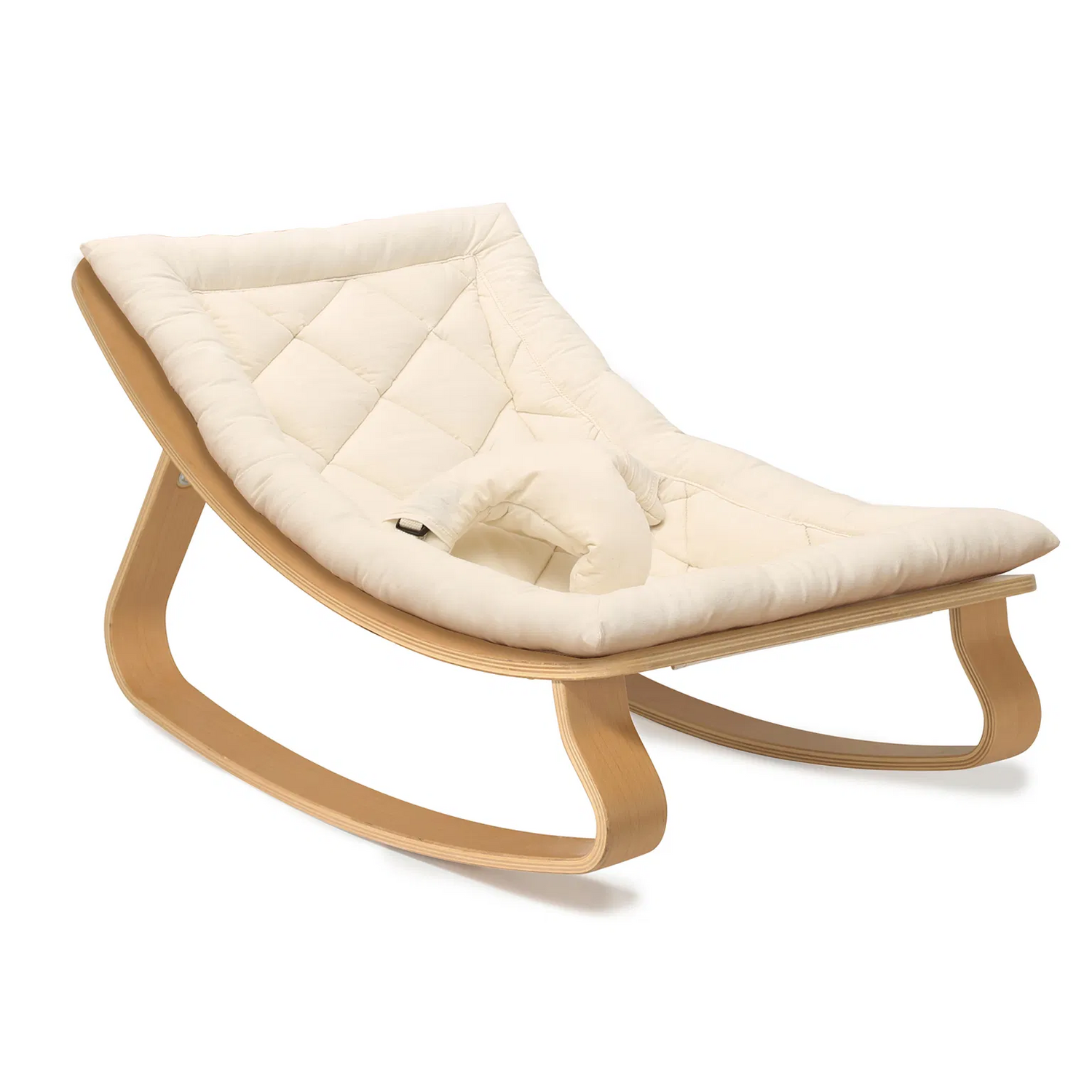
At Charlie Crane, the KUKO bassinet is designed for little ones from birth to around 5–6 months, while the KUMI cradle can be used up to 6 months. This progression helps you plan each stage without making last-minute purchases, while retaining natural materials and European manufacturing.
Frequently Asked Questions
Must you avoid any gap between the mattress and the bassinet? Yes. A gap between the mattress and the sides poses a risk of entrapment or even suffocation. The mattress dimensions must match the sleep space exactly, without exception.
Does a firm mattress make a baby less comfortable? No. An infant’s comfort depends on support suited to their low weight, not softness. A mattress that is too soft can instead pose a safety risk.
Does a mattress made from natural materials guarantee safety on its own? No. Natural materials offer softness and an absence of chemical treatments, but safety depends on the mattress’s density, thickness and exact fit in the sleep space.
Can you reuse the same mattress in a crib? No. The dimensions of a mattress for a bassinet or cradle are fixed, so it will not fit a larger crib. You need a new mattress that matches the dimensions of the next bed exactly.
How do you choose the right sleep sack? Choose one for your child’s age and the season to keep them from getting too warm or too cool, alongside a properly fitted sheet and mattress protector.


